Halos and glare around lights are common in the first weeks after a multifocal lens is placed during cataract surgery. For many people they become less noticeable over the following months as the brain learns to work with the new optics, a process called neuroadaptation. In one brain-imaging study of people with multifocal lenses in both eyes, the extra visual effort seen three weeks after surgery had settled by six months. Some people still notice halos after that point, and when complaints persist, the cause is often something that can be checked and treated, such as leftover prescription or dry eye, rather than the lens design itself. A monofocal lens tends to suit people who drive at night often, people with certain eye diseases or an irregular cornea, and people who would rather use reading glasses than accept rings around lights.
This piece follows on from our comparison of monofocal, EDOF and multifocal lenses, which explains how each design handles light. Here the focus is what comes after the choice: what halos and glare are, how adaptation works and how long it tends to take, what to check when it does not settle, and who may be better served by a monofocal lens from the start.
What halos and glare look like with a multifocal lens
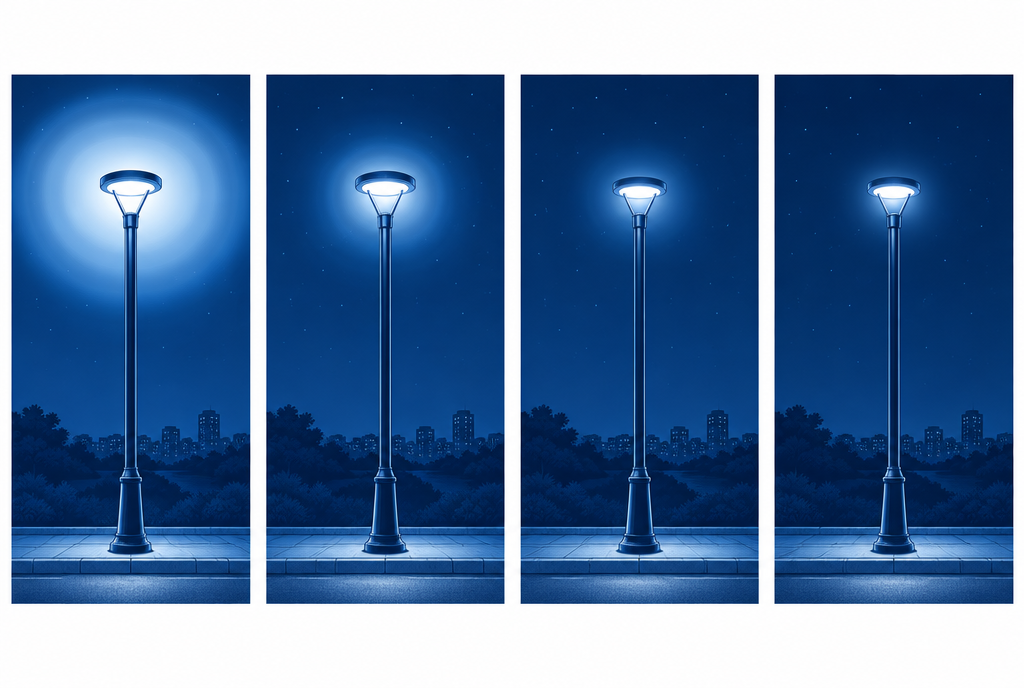
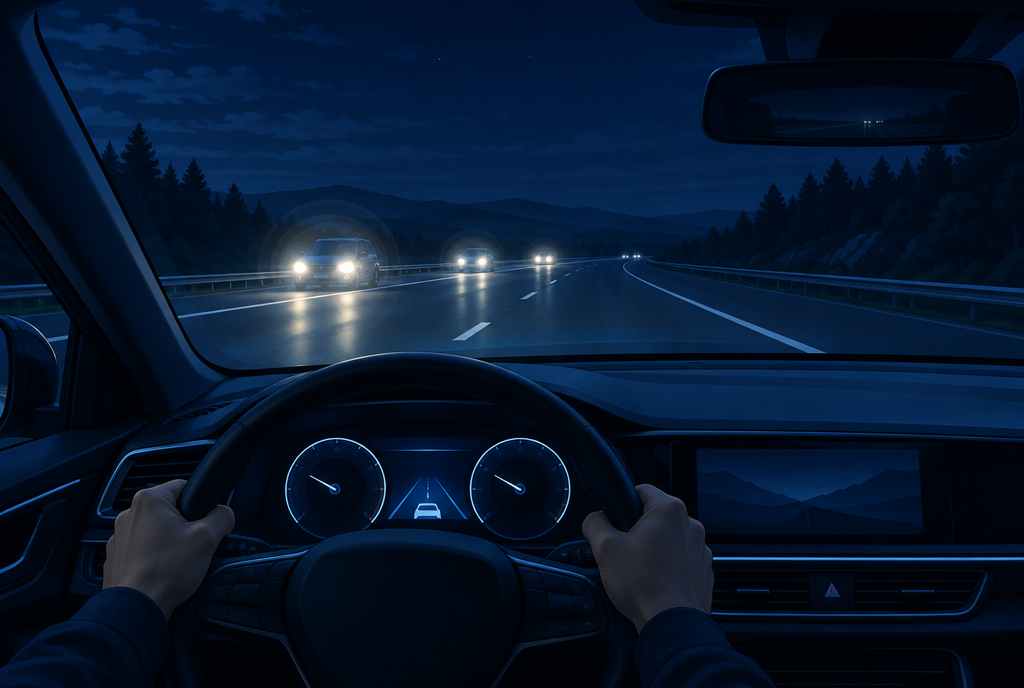
People describe the same few things. A halo is a ring or circle of light around a bright source, such as a headlight or a street lamp. Glare is scattered light that makes it harder to see near a bright source, for example beside oncoming headlights. Some people also see starbursts, thin rays coming out of a light, or notice that a grey road at dusk looks a little flatter than it used to. These effects show mostly in the dark, when the pupil is wider and small bright lights stand out against a black background.
They come from the way a multifocal lens works. It divides incoming light between several focal points so that far, middle and near can all be used. At any moment one image is in focus and the others are not. Against a bright, busy scene the out-of-focus light is hard to notice. Around a single bright light at night, it can show up as rings.
The size of the difference has been measured. A Cochrane review of 20 randomised trials, covering 2,230 people, compared multifocal with monofocal lenses after cataract surgery. People with multifocal lenses were less dependent on glasses, and they reported haloes about three and a half times as often as people with monofocal lenses. Glare was also reported more often. The review's authors concluded that whether the near-vision benefit outweighs these effects varies between people, and that motivation to be free of glasses is likely to be the deciding factor.
Two points help put this in context. First, light effects are not limited to multifocal lenses. A review of monofocal lens reports describes arcs or streaks caused by light reflecting off the lens edge, and a dark crescent at the side of vision in some people. Second, many people already have glare before surgery, because a cataract itself scatters light. GS Eye Center lists glare and difficult night driving among its cataract self-check signs. Halos after laser vision correction have a different cause, linked to the treated zone of the cornea, and our article on night driving after vision correction covers that case.
What neuroadaptation is, and what the research shows
Neuroadaptation means the brain learning to interpret a new kind of image. The lens does not change after surgery. What changes is how the visual system handles the overlapping in-focus and out-of-focus light.
A study at the University of Coimbra in Portugal followed 30 people who had diffractive multifocal lenses in both eyes, using functional MRI at three weeks and six months after surgery. At three weeks, viewing faint patterns under glare activated brain areas linked to attention, effort and learning. By six months that pattern had returned to a more effortless one, and glare no longer reduced the brain's response to the patterns. Over the same period symptom scores fell and reading performance improved, while optical measurements of the eyes did not differ. In other words, the improvement came from the brain, not from the lens.
The American Academy of Ophthalmology states that most people adapt to glare, halos and loss of contrast with these lenses, and that people who drive at night a lot may be happier with monofocal lenses. A 2025 review of night driving after lens surgery found that driving after dark can remain difficult for some multifocal patients whose adaptation is not yet complete. GS Eye Center's Chinese-language lens page says the same in practical terms: multifocal lenses need an adaptation period, its length differs from person to person, and night driving should be resumed gradually once vision has stabilised.
The second eye matters as well. GS Eye Center operates on one eye at a time, usually one to two days apart. In the days between, one eye has the new lens and the other does not, so the overall impression is not yet the final one.
A typical adaptation timeline
The table describes a common pattern, not a promise for any one person. Your surgeon sets the follow-up schedule for your eyes and the lens used.
| Period after surgery | What people often notice | What usually helps | Contact the clinic sooner if |
|---|---|---|---|
| Between the first and second eye | The two eyes do not match yet | Follow the drop schedule and check-ups; hold off judging the result | Pain, or a drop in vision |
| First weeks | Halos and glare around lights at night; near or middle vision may feel effortful | Good light for reading; no night driving until your surgeon clears it | Sudden loss of vision, eye pain or an injury (see an eye doctor in person first) |
| One to three months | Light effects may be easing; leftover blur or dryness becomes easier to tell apart | Ask for a refraction check and a dry eye check | Blur at all distances that is not improving |
| Around six months | In the imaging study above, the brain's effort pattern had settled by this point | Review with your doctor whether what remains is adaptation or something else | Symptoms that still affect driving or daily tasks |
| Beyond six months | Some people still notice halos | A structured check for treatable causes before any further surgery is discussed | Problems that limit work or driving |
When halos do not settle: causes worth checking
Lasting complaints do not always mean the brain has failed to adapt. Several causes can be found and often treated.
A clinic study at Bascom Palmer Eye Institute in Miami looked at 49 people (74 eyes) who came in specifically because they were unhappy after a presbyopia-correcting lens. These were dissatisfied patients only, so the figures describe causes, not how often dissatisfaction happens. The most common complaint was blurry or foggy vision at both distance and near (68% of eyes). The most frequent identifiable causes were leftover refractive error (57%) and dry eye (35%). Treatment was mostly conservative: glasses or contact lenses (46%) and dry eye treatment (24%). Laser correction on the cornea was used in 8% of eyes, and 7% needed the lens exchanged. After treatment, 45% of patients said their symptoms had resolved, 23% were partly satisfied and 32% remained dissatisfied.
A review in Survey of Ophthalmology lists the usual causes of blur and light effects with multifocal lenses:
- Leftover prescription. Even a small remaining focusing error can blur vision. Glasses, contact lenses or a laser touch-up on the cornea are the usual fixes.
- Dry eye. An uneven tear film blurs the image before light even reaches the lens. It is treated on its own terms.
- Posterior capsule opacification. The thin capsule holding the lens can become cloudy months or years later. The American Academy of Ophthalmology describes a laser procedure, posterior capsulotomy, that makes an opening in the cloudy capsule.
- Lens position. A lens that sits off-centre can add blur and light effects.
- Large pupils. A pupil that opens wide in the dark has been linked with more light effects.
Lens exchange is possible, but it is another operation inside the eye with its own risks, and it is usually considered after other causes have been dealt with. In one trial included in the Cochrane review that compared multifocal lenses with monovision, six people in the multifocal group had their lens exchanged in the first year, compared with none in the monovision group.
Who may do better with a monofocal lens
A monofocal lens gives one clear distance, usually far, with reading glasses for close work, and it tends to produce fewer night-time light effects. For some people that trade is the better fit from the start.
| Your situation | Why it matters | What is often discussed instead |
|---|---|---|
| You drive at night often, or for work | The AAO notes that frequent night drivers may be happier with monofocal lenses | Monofocal or enhanced monofocal; a design with fewer light effects |
| Halos or small visual flaws bother you a lot | GS Eye Center's Chinese-language lens page names low tolerance for halos as a reason to discuss the lens type with the doctor | Monofocal, with glasses for near tasks |
| Glaucoma, macular disease or diabetic retinopathy that is not under control | These reduce the quality of the image the retina receives; multifocal lenses need careful assessment | Monofocal; monovision if avoiding glasses matters |
| Irregular astigmatism or keratoconus | GS Eye Center's Chinese-language lens page does not advise multifocal lenses for these | Other lens types, decided after corneal imaging |
| You do not mind reading glasses | The Cochrane review points to motivation for being glasses-free as the likely deciding factor | Standard monofocal set for distance |
| You already got on well with monovision contact lenses | The AAO suggests trying monovision contacts before surgery to see if it works for you | Monovision with monofocal lenses |
There is also a middle ground. GS Eye Center stocks nine premium lenses from Alcon, ZEISS, Hoya, Ophtec and Johnson & Johnson, covering enhanced monofocal, extended depth of focus, non-diffractive and trifocal or quadrifocal designs. The lens is chosen after biometry on the IOL Master 700, 3D imaging of the front of the eye on the GALILEI G4 and an interview about the distances you use each day. The clinic also states that it does not perform cataract surgery on eyes that do not have cataracts, so this choice comes up only when there is a cataract to treat.
Testing your own priorities before the consultation
A lens recommendation is only as good as the information you bring. A few days of honest self-observation help more than reading lens brochures.
- Count your night driving. How many evenings a week, on lit city streets or on dark highways, and is any of it for work?
- Notice how you use glasses now. Which tasks would you happily keep glasses for, and which ones would you really like to do without them?
- Think about tolerance. If rings around headlights stayed noticeable for months, would that be a mild annoyance or a daily problem for you?
- Ask about a monovision trial. If your eye doctor at home thinks it is suitable, wearing monovision contact lenses for a while shows how your eyes and brain handle one eye set for distance and one for near.
- Write it down. Bring the notes to the consultation, together with your prescription history and any previous eye surgery records.
Planning the trip and the adaptation period from North America
Most of the adaptation happens after you fly home, so plan for it.
- Allow for both eyes. GS Eye Center operates on one eye at a time, usually one to two days apart. Your coordinator maps the exam day and both surgery days onto your travel window before you book flights.
- Take your records home. Before departure, the clinic prepares an English summary of your surgery and exam data that an eye doctor near you can use for routine checks.
- Get night driving advice in writing. Ask when you can drive after dark and what would be a reason to get in touch, so the answer is clear weeks later at home.
- Know where to go for urgent symptoms. Sudden pain, sudden loss of vision or an eye injury needs in-person care near you first. Message the clinic afterwards, not instead.
- Use the messaging line for the rest. If halos are still bothering you after a few months, your local eye doctor can check your prescription, tear film and lens capsule, and the results can be shared with the GS clinical team through your coordinator.
GS Eye Center (GS안과) is an eye clinic at Gangnam Station Exit 1, Seoul, open since 2005. Six of its doctors perform cataract surgery, and the lens for each patient is chosen after the pre-operative exam and a lifestyle interview.
This article was written from GS Eye Center's published information and the doctors' explanations. It is general information, not a diagnosis or a treatment recommendation for any individual.