Monofocal, extended depth of focus (EDOF) and multifocal lenses differ in how many distances they try to bring into focus after cataract surgery, and in what they give up to do it. A monofocal lens gives one sharp distance, usually far, and you wear reading glasses for close work. An EDOF lens stretches clear vision from far into the middle range, such as a computer screen, with a smaller chance of halos than a multifocal. A multifocal lens aims at far, middle and near together, so glasses are needed less often, but halos and glare around lights at night are more likely. Which one fits is decided by measurements of your eye and by the distances you actually use each day, not by the lens name.
The rest of this piece explains why each design behaves the way it does, what the exam checks before a lens is proposed, and what to ask.
What an intraocular lens does, and what it cannot
A cataract is a clouding of the eye's natural lens. In surgery that lens is removed and an intraocular lens (IOL) is placed in the same capsule. The new lens is intended to stay in the eye for life. Exchanging it later is possible in some cases, but it is another operation, which is why the choice deserves time before surgery rather than after.
An IOL cannot change the health of the retina or the optic nerve, and it cannot reshape the cornea. If either of those limits your vision, a more elaborate lens will not fix it, and in some cases a more elaborate lens makes the problem more noticeable. That point comes back in the exam section.
One more boundary: the lens choice only arises when there is a cataract to remove. GS Eye Center states on its lens page that it does not perform cataract surgery on eyes without cataracts. If your difficulty is reading distance while your natural lenses are still clear, the options are different, and our piece on presbyopia options covers them.
Three designs, three ways of handling light
The differences between lens types are easiest to understand as different ways of distributing the light that enters the eye.
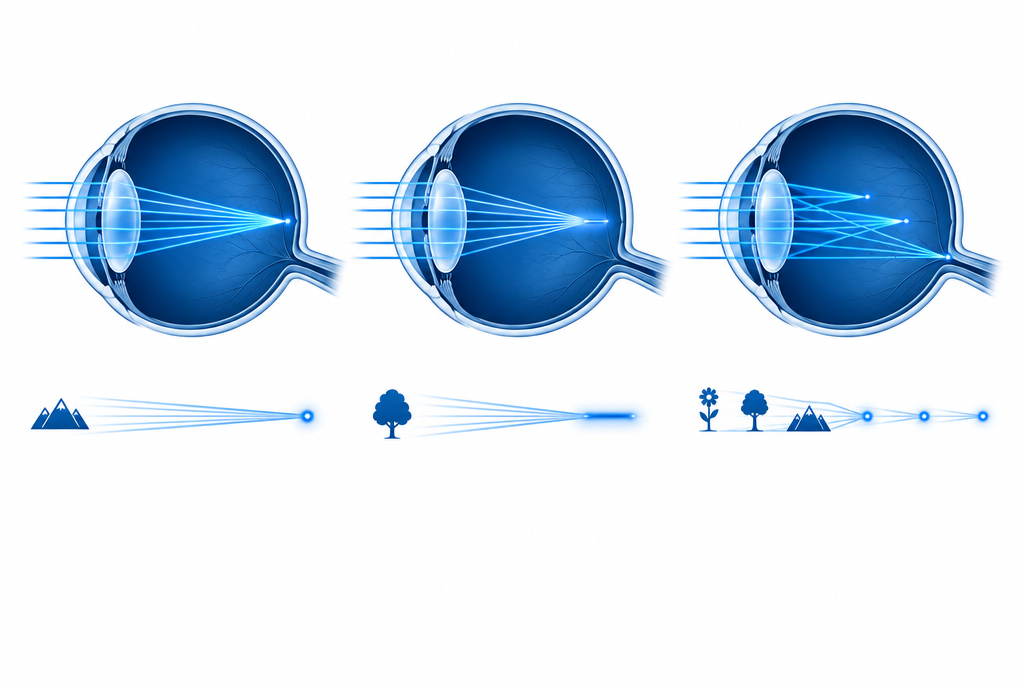
A monofocal lens sends all of it to one focal point. The surgeon and patient choose that point, usually distance. Everything at that distance is as crisp as the rest of your eye allows, and objects closer than it gradually blur. Some monofocal lenses are described as "enhanced": they are shaped to give a little more usable range toward the middle distance while behaving at night much like a standard monofocal.
An EDOF lens stretches the focus into a longer zone rather than a point. Distance and the middle range, roughly a car dashboard or a monitor, tend to be usable together. Small print at reading distance often still needs glasses, although this varies by design and by eye.
A multifocal lens, including trifocal and quadrifocal designs, splits light between several focal points so that far, middle and near are all served at once. The brain learns to attend to whichever image is in focus. The price of that split is paid in light: each focal point receives only part of it, and out-of-focus light can show up as rings or halos around bright sources in the dark.
Many lens families also come in toric versions, which correct corneal astigmatism at the same time. Whether you need one depends on how much astigmatism your cornea has and how regular it is.
Side by side: what each type tends to give you
The table below describes tendencies, not results for any one person. The outcome in your eye depends on your measurements, the other eye, and how your brain adapts.
| Lens type | Distances that tend to be clear | Chance you still need glasses | Chance of halos or glare at night | Daily life it tends to suit |
|---|---|---|---|---|
| Standard monofocal (set for distance) | Far | High for reading and phone; sometimes for the computer | Low | Frequent drivers and people who do not mind reading glasses |
| Monofocal with monovision (one eye far, one eye near) | Far with one eye, near with the other | Moderate; some tasks still need glasses | Low | People who already got on well with monovision contact lenses |
| Enhanced monofocal | Far, plus a little more of the middle range | High for small print | Low, similar to a standard monofocal | People who want night vision close to a monofocal with slightly more screen range |
| EDOF | Far through the middle range | Moderate; often for fine print | Low to moderate | Screen work and driving, for people cautious about night halos |
| Multifocal (trifocal or quadrifocal) | Far, middle and near | Lower than the other types, though not zero | Moderate to higher, often easing over months | Frequent reading and close work, for people keen to reduce glasses |
Reading down the columns shows the pattern: every step toward fewer glasses also moves toward more night-time light effects. No lens design removes that trade-off entirely. The designs differ in where they place it.
The trade-offs worth hearing before surgery
Halos and glare. With multifocal lenses, rings or starbursts around headlights and street lamps are common in the early weeks. For many people they become less noticeable over the following months as the brain adapts. For some they remain noticeable. If you drive at night for work or often, say so in your consultation: it is one of the facts that most directly shapes the recommendation.
Contrast in dim light. Because multifocal designs divide light, some people notice that low-contrast scenes, such as a grey road at dusk, look slightly less crisp than with a monofocal. EDOF designs generally sit between the two.
Adaptation time. A monofocal usually feels settled quickly. Multifocal and EDOF lenses can take longer before vision feels natural, because the brain is learning to use a new optical system. Patience in the first months is part of the plan, not a sign that something went wrong.
The second eye. Most people have cataracts in both eyes, and the two eyes are often planned together. Using the same design in both, or combining designs, is a decision made with the surgeon on the basis of measurements.
What the exam decides before you do
The lens is the last decision in the process. Before any lens is proposed, the eye is measured: its length, the curvature and shape of the cornea, the depth of the front chamber, and the health of the retina and optic nerve. At GS Eye Center, biometry is taken on an IOL Master 700, the front of the eye is imaged in 3D on a GALILEI G4, and a lifestyle interview records the distances you actually use, whether that is reading, screens, driving or sport.
Several findings can move a surgeon away from a multifocal design even when a patient wants one. Macular disease, glaucoma, an irregular cornea and untreated dry eye all reduce the quality of the image the retina receives, and splitting that image further can make things worse. In these situations a monofocal, enhanced monofocal or particular EDOF design may be the more suitable choice.
Previous laser vision correction matters too. SMILE, LASIK and LASEK change the cornea's shape, which makes the lens power calculation harder. Records of your measurements from before that surgery help, and our article on cataract after SMILE or LASIK explains which ones to keep.
GS Eye Center (GS안과) is an eye clinic at Gangnam Station Exit 1, Seoul, open since 2005. It stocks several premium lens designs, from enhanced monofocal through EDOF to trifocal and quadrifocal, and the lens offered to you follows the exam rather than a preference set in advance.
Questions to bring to your consultation
- At which distance will I see most clearly with the lens you suggest, and for which tasks will I probably still need glasses? A specific answer is more useful than a general one.
- What did my measurements show that affects the choice? Ask about the retina, the cornea and astigmatism in particular.
- How likely are halos with this design in my eyes, and how are they usually managed?
- What is the plan for the second eye?
- If I fly home soon after surgery, how will follow-up work? Travel plans belong in the discussion from the start.
Fees for lenses and surgery are quoted individually after the exam, because they depend on the lens and on the eye.
This article was reviewed by the medical team at GS Eye Center for clinical accuracy. It is general information about intraocular lens types and not a diagnosis or a treatment recommendation for any individual.