Nine lenses. One is matched to your life.
An intraocular lens (IOL) replaces the clouded natural lens removed in cataract surgery. GS Eye Center stocks nine premium IOLs - from enhanced monofocal to quadrifocal designs by Alcon, ZEISS, Hoya, Ophtec and Johnson & Johnson - and matches one to your eyes, your work and your lifestyle.
Monofocal or multifocal - what is the difference?
Every IOL conversation starts here: one clear distance with reading glasses, or multiple distances without them.
| Item | Monofocal IOL | Multifocal IOL |
|---|---|---|
| Focus | One distance - near or far | Multiple focal points, near through far |
| Vision improved | At the chosen distance only | Near, intermediate and far together |
| Reading glasses after surgery | Needed | Not needed by design |
| Suited to | Less near work, lower activity levels | Frequent near work, active lifestyles |
| Surgical difficulty | Comparatively straightforward | Comparatively demanding |

Life happens at three distances
A phone at arm's length, a screen across the desk, a street across the harbor: a multifocal IOL is engineered to keep all three usable at once, treating the cataract and presbyopia in one procedure. A monofocal lens gives you one of those distances sharply - typically far - and reading glasses cover the rest. Neither is “better”; they suit different lives, which is why the exam and lifestyle interview come before the lens decision.
“GS Eye Center does not perform cataract surgery on eyes that do not have cataracts.”
A premium lens is only proposed when there is a cataract to remove. If you have presbyopia without a cataract, the conversation moves to ArtiPLUS or laser options instead - see the overview.
Which nine lenses does GS stock - and what is each for?
Details below are as published by the clinic, per manufacturer descriptions. The lens actually offered to you follows your exam.
| Lens | Maker · Origin | Design | What the clinic highlights |
|---|---|---|---|
| Clareon PanOptix Pro | Alcon · USA | Quadrifocal (multifocal) | ENLIGHTEN NXT technology with a stated 94% light utilization. Continuous vision from near through far with reinforced contrast; reduced light scatter to ease night glare and halos. |
| Clareon PanOptix | Alcon · USA | Quadrifocal (multifocal) | The established PanOptix four-focal design on the Clareon material. A 60 cm intermediate point suited to computer work and cooking; reduced halos and posterior capsule opacification. The clinic cites manufacturer survey data in which 99% of patients said they would choose the same lens again. |
| AT LISA tri | Carl Zeiss · Germany | Trifocal | Improved near vision with reduced night-vision disturbance and halos, built on ZEISS's 175 years of optics. Low dependence on glasses. |
| AT LARA | Carl Zeiss · Germany | Extended depth of focus (EDoF) | Continuous focus with reduced night-vision disturbance and halos; a diffraction-grating design that also lifts contrast sensitivity. Sharp from intermediate distance outward. |
| AT ELANA | Carl Zeiss · Germany | Trifocal | Strength in 30-40 cm near vision. Patented SMP technology to reduce glare and halos; biocompatible material with high light utilization. |
| VIVINEX GEMETRIC | Hoya · Japan | Trifocal | Dual-convex optic covering far distance down to 35 cm. Refined diffraction rings with Gaussian smoothing minimize night halos and light loss; diffraction concentrated within 3.2 mm maximizes light efficiency. Rear-surface toric design favors astigmatism correction, and textured haptics minimize lens rotation. |
| PRECIZON GO | Ophtec · Netherlands | Non-diffractive aspheric | Natural vision from far through intermediate. With no diffractive rings it produces fewer halos than diffractive designs - a fit for night driving and sports - and its use of spherical aberration supports fast adaptation. |
| AcrySof IQ Vivity | Alcon · USA | Extended depth of focus (EDoF) | FDA-approved wavefront-shaping (X-wave) technology with halo levels similar to a monofocal lens. FDA-documented acuity: 1.0 at distance, 0.8 or better at intermediate, 0.63 at near. High contrast sensitivity makes it a candidate when retinal disease or glaucoma coexists. |
| TECNIS Eyhance | Johnson & Johnson · USA | Enhanced monofocal | Higher-order aspheric refractive design that sharpens everyday intermediate distance (66 cm). No diffractive rings or zones, so glare and halos are reduced; corrects spherical and chromatic aberration. |
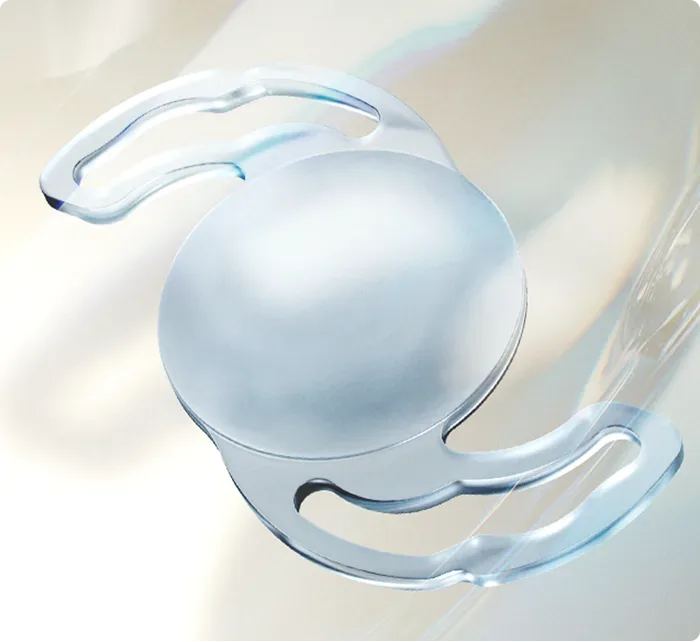
Three of the lens designs
How is my lens chosen?
The lens is the last decision, not the first. Biometry on the IOL Master 700 and 3D anterior imaging on the GALILEI G4 measure your eye; a lifestyle interview establishes the distances you actually live at - reading, screens, driving, sport. The surgical plan and lens follow from both. The clinic's published implant volumes with these lens families are part of that experience.

IOL FAQ
That is the design intent: a multifocal IOL restores near, intermediate and far vision together, so reading glasses are not needed. A monofocal IOL corrects one distance and reading glasses remain necessary. Which design suits you depends on your eyes and daily distances - the exam decides.
No - it is an enhanced monofocal. It has no diffractive rings, which keeps glare and halos low, while its aspheric design sharpens the everyday 66 cm intermediate range beyond a conventional monofocal.
Not necessarily. Among the stocked lenses, AcrySof IQ Vivity is the one the clinic flags for coexisting eye disease because of its high contrast sensitivity and monofocal-like halo profile. The retina team and cataract surgeon review such cases together - see the retina clinic.
Several take different routes: PRECIZON GO avoids diffractive rings entirely, Vivity's wavefront-shaping keeps halos near monofocal levels, and PanOptix Pro reduces light scatter. If you drive at night a lot, say so in your consultation - it directly shapes the recommendation.
Korean regulations limit publishing medical prices online, so lens and surgery fees are quoted individually. Send your prescription and history through the pricing inquiry and a coordinator will respond with specifics.