VISU LASIK
VISU LASIK is GS Eye Center's all-laser LASIK on the ZEISS VisuMax: both the corneal flap and the correction are made by laser, never a blade. A low-energy protocol and a 135-degree bevel-in flap edge support a comfortable, fast recovery - built for patients who need to be back to daily life the next day.
Why all-laser, and never a blade?
Blade-based flap cutting carries risks of bacterial infection and complications - which is why GS performs LASIK flaps exclusively by femtosecond laser.
The femtosecond laser forms a thin corneal flap - no blade touches the eye.
The flap is lifted and the stroma is reshaped by laser to your prescription.
The flap is repositioned and settles without stitches; healing begins immediately.
The clinic's checklist for this procedure: all-laser process, fast visual recovery, reduced pain, lower risk of corneal haze, no steroid dependence, and easy secondary enhancement later if a touch-up is ever needed.
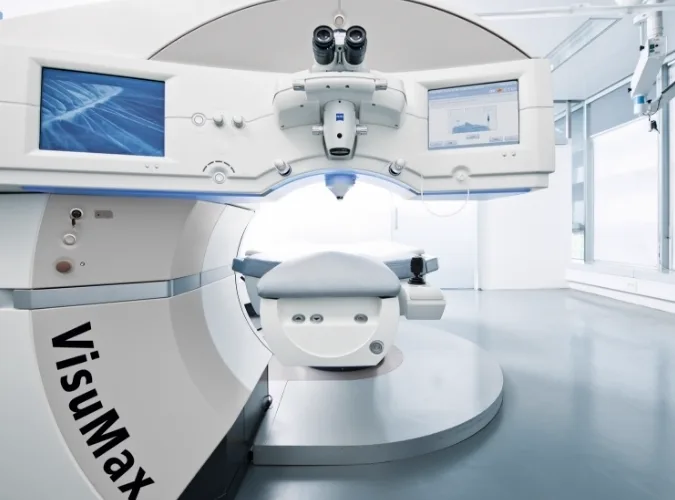
ZEISS VisuMax
The German femtosecond platform behind VISU LASIK. GS runs the same platform family used for its SMILE procedures - see surgical equipment.
What does the VisuMax change about LASIK?
Laser speed
500,000 pulses per second - about 3.5 times faster than earlier systems, shortening heat exposure during flap creation.
Micro beam
A fine laser spot for precise correction and a smooth cutting surface.
600× lower energy
A low-energy, low-pressure protocol that avoids intraocular pressure spikes and conjunctival redness, reducing risks of optic-nerve stress, corneal haze and regression.
Curved corneal interface
Fixes the eye at the cornea on a 3D curved surface - unlike conjunctival fixation, it avoids optic-nerve compression and redness while tracking fine movements during surgery.
Bevel-in flap edge
The flap edge is cut at 135 degrees so it locks back like a tightened screw - firmer against external impact, faster to stabilize.
Flap + refraction in one platform
Handles flap creation and myopia-astigmatism correction, extending to hyperopia and, in suitable cases, presbyopia-related correction.
Who is VISU LASIK for?
Around 50 precision exams decide whether your eyes support LASIK - and which method fits them better.
VISU LASIK questions
The clinic recommends age 18 or older, once the prescription has been stable - no change in strength over roughly six months - because vision usually keeps shifting through the teenage years.
Long-term lens wear itself does not rule out surgery. If an eye condition is found, it is treated first; the 50-item precision exam determines whether and when your eyes are ready.
You can go home without a guardian on the day of surgery - but you cannot drive yourself, so plan transport or use the subway; the clinic is directly at Gangnam Station Exit 1.
Dry eye, night glare and halos can occur after surgery. Most cases the clinic describes are mild and improve within six months; your surgeon reviews them at each follow-up.
For patients who live far away, the clinic adjusts visit schedules to minimize trips and can coordinate ongoing checks with an eye clinic near you. International patients: see After You Fly Home.