LASEK is still chosen when a treatment without any flap or internal pocket suits the eye, or the person's life, better than LASIK or SMILE. The usual reasons are a cornea that is thin for the size of the prescription, certain problems with the cornea's surface layer, and a sport or job in which the eye may take a hard knock. In LASEK the thin outer skin of the cornea is moved aside, the laser reshapes the tissue just beneath it, and the surface grows back over a few days. That leaves more of the cornea's load-bearing middle layer untouched. The trade-off is recovery: most people have a few uncomfortable days, and vision usually keeps sharpening over several weeks. Which method fits a particular eye is decided by the screening exam, not by preference alone.
This article explains how surface treatment differs from LASIK and SMILE, the corneal and lifestyle reasons it stays on the list, what the first days and months are really like, and why haze prevention and sun protection matter afterward. LASEK and PRK are close relatives that differ mainly in how the surface layer is removed, so most of what follows applies to both.
How surface ablation differs from LASIK and SMILE
The cornea has a thin outer skin called the epithelium, which renews itself, and a much thicker middle layer called the stroma, which gives the cornea its strength and its shape. All three laser methods correct vision by changing the shape of the stroma. They differ in how they reach it.
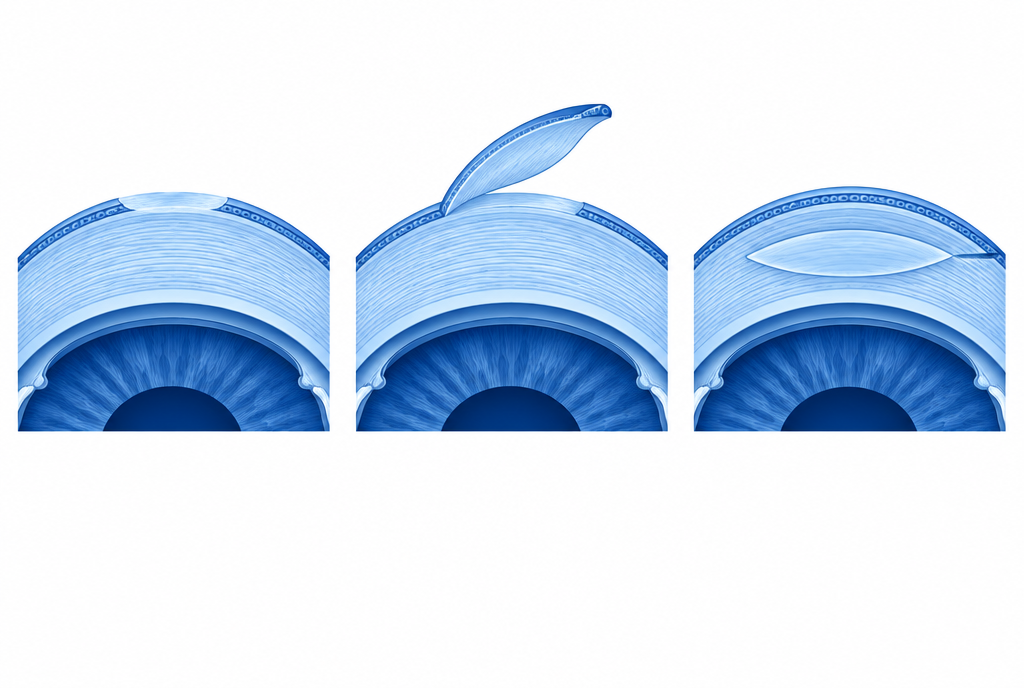
- LASIK cuts a thin hinged flap across the front of the cornea, folds it back, reshapes the stroma underneath with a laser and lays the flap back down. The flap sticks well, but the tissue never regains its full original bond, and the layer above the cut adds little to the cornea's strength afterward.
- SMILE uses a laser to shape a thin disc of tissue inside the cornea, which is then removed through a small incision. There is no hinged flap. A layer of corneal tissue (the cap) stays on top.
- LASEK and PRK remove only the epithelium, using diluted alcohol, a brush or the laser itself, then reshape the very front of the stroma. Nothing is cut deeper into the cornea. A soft bandage contact lens protects the eye while the epithelium grows back.
Because surface treatment works at the front and leaves no flap or cap, it usually preserves more untouched stroma for the same correction. That point helps explain many of the situations in which LASEK is still considered.
Corneal reasons LASEK stays on the table
A cornea that is thin for the prescription. Every laser plan has to leave a safe amount of untouched stroma behind. A flap or a cap uses up some thickness that no longer contributes much strength. When the numbers are tight for LASIK or SMILE, surface treatment may still leave a comfortable margin. Thickness is only one part of that calculation, alongside the prescription and the shape of the cornea. Our article on SMILE Pro with high myopia or thin corneas walks through how those values interact.
Thin is not the same as weak. If the corneal map shows a pattern that suggests keratoconus or a tendency to bulge, the problem is not solved by switching from a flap to surface treatment. Laser reshaping of any kind may be ruled out, and other options are discussed instead. This is one reason the screening exam measures shape as well as thickness.
Some surface-layer conditions. In a condition sometimes called map-dot-fingerprint dystrophy, the epithelium is loosely attached. Cutting a flap through that layer can lead to healing problems, so surgeons often prefer surface treatment, which removes the loose epithelium and lets a new layer grow back.
Eye and eyelid anatomy. Flap and lenticule surgery both rely on a suction device placed on the eye. Deep-set eyes or a narrow eyelid opening can make it hard to position, and surface treatment does not need it in the same way.
Prescriptions beyond laser range. Surface treatment does not stretch the limits indefinitely. For very high prescriptions, deeper treatments raise the chance of haze, and an implantable lens (ICL) is often discussed instead. Our comparison of SMILE, LASIK and ICL covers where each one tends to fit.
Dry eye is sometimes mentioned as a reason too. Corneal nerves appear to recover somewhat faster after surface treatment than after a flap, but any significant dry eye needs treating before laser surgery of any kind, and surface treatment causes its own temporary dryness while the eye heals.
Contact sports and high-impact work
After LASIK the flap heals firmly at its edge, but it does not fully fuse with the tissue beneath. In rare cases a strong blow at the right angle can lift or shift it, sometimes years after surgery. A displaced flap can usually be repositioned, but it is an urgent problem that needs prompt care.
For that reason, people whose eyes are more likely to be struck are often steered away from flap surgery. Examples include boxing, mixed martial arts, wrestling, ice hockey, football and rugby, as well as police, military and firefighting work, and jobs around heavy tools or large animals.
- LASEK leaves nothing to dislodge once the surface has healed.
- SMILE has no hinged flap and only a small incision, so it is generally considered less vulnerable to this kind of injury than LASIK. Some active people choose it because recovery is faster. Whether that applies to your eyes and your sport is a question for the surgeon.
- LASIK remains an option for many active people, but the flap is the one thing worth weighing honestly if your work or sport involves regular impact.
No laser method protects the eye itself. A blow strong enough to injure the retina or the eyeball does so regardless of which surgery you had, so protective eyewear still matters in high-risk sports.
LASEK, SMILE and LASIK side by side
The table shows general tendencies. Individual results vary, and the right choice for a given eye comes from the exam.
| LASEK (surface ablation) | SMILE | LASIK | |
|---|---|---|---|
| How the cornea is reached | Outer skin removed; front of the stroma reshaped | Thin disc of tissue removed through a small incision | Hinged flap lifted; stroma reshaped underneath |
| Corneas it tends to suit | Thinner corneas, some surface-layer conditions, eyes hard to fit with a suction device | Adequate thickness; myopia with or without astigmatism | Adequate thickness and a normal corneal shape |
| Early discomfort | Usually the most: soreness, tearing and light sensitivity for the first two to three days | Usually mild, often for a day or so | Usually mild, often for a few hours |
| Return to desk work | Often after about a week | Often within a few days | Often within a day or two |
| Vision settling | Improves over weeks; often considered stable after several months | Often clear within days, settling over weeks | Often clear the next day, settling over weeks |
| Resistance to a direct blow | No flap, nothing to dislodge once healed | No hinged flap; generally considered less vulnerable than LASIK | Flap can rarely be displaced by trauma, even years later |
| Main things to weigh | Slower, less comfortable recovery; haze prevention; longer course of drops | Suitability set by thickness and prescription | Flap-related complications; dry eye in some people |
Read the rows together and the pattern is clear. LASEK usually means a slower, less comfortable first week, while often preserving more untouched corneal tissue and leaving no flap. SMILE and LASIK recover faster but need enough corneal thickness to start with.
What LASEK recovery is realistically like
Knowing the timeline in advance makes the first week much easier. The stages below are typical, not fixed.
- Surgery day. The treatment itself takes minutes per eye. A bandage contact lens goes on, and most people go back to rest. Vision is blurry.
- Days one to three. These are usually the hardest. Expect a gritty or burning feeling, watering and sensitivity to light. Pain relief is prescribed, and most people stay home, keep their eyes closed for long stretches and avoid screens. Vision may blur and clear through the day.
- Around days three to five. The epithelium closes over the treated area, discomfort fades quickly, and the bandage lens is removed at a check-up. Do not take it out yourself.
- The first few weeks. Vision is usable but often a little soft or fluctuating, especially when the eyes are dry. Many people return to desk work after about a week. When you may drive is decided by the doctor at a check-up.
- The following months. Vision keeps settling as the new surface smooths out. The correction is often judged stable a few months after surgery, which is also when any decision about further treatment would be made.
During this period, avoid rubbing your eyes. Swimming, hot tubs, saunas and eye makeup are usually put off until the doctor says the surface has healed well enough.
Haze, steroid drops and sun protection
Haze is a faint cloudiness that can form under the new surface as the cornea heals. A mild degree is common and usually not noticeable. It tends to appear in the weeks after surgery and peak within the first couple of months, and it is more likely after deeper treatments and with strong sun exposure. Noticeable haze can blur vision or cause glare. It often fades with time or responds to treatment, but prevention is the better route.
- Medication during surgery. For some treatments, especially deeper ones, surgeons apply a medication to the eye during the procedure to lower the chance of haze.
- Steroid drops. Anti-inflammatory steroid drops are usually tapered over weeks to a few months. Follow the schedule exactly. Stopping early can raise the haze risk, and staying on them longer than prescribed is not advised either. In some people steroid drops raise eye pressure, so pressure checks are part of the follow-up.
- Sun protection. Ultraviolet light can encourage haze after surface treatment. Wear UV-blocking sunglasses outdoors for as long as your doctor advises, often several months, and add a brimmed hat in strong sun. Beaches, snow and high altitude reflect a lot of light.
For overseas patients, the drop schedule usually continues after the flight home. Arrange an eye doctor near home who can check the eye pressure and the healing while you taper.
Planning LASEK around a trip to Seoul
Surface treatment needs more calendar time than SMILE or LASIK, mostly because of the bandage lens and the early check-ups.
- Screen first. Whether LASEK, SMILE or LASIK suits your eyes depends on the corneal measurements, so the exam comes before any decision.
- Allow for the early visits. The bandage lens is usually removed at a check-up a few days after surgery, and a further check is usually wanted before you fly. The exact schedule is set by the clinic.
- Plan the first days as rest days. Sightseeing in the first few days is unrealistic. A companion helps, and dark glasses are useful indoors as well as out.
- Flying. Cabin air is dry, so keep lubricating drops in your hand luggage. Fly only when the doctor has cleared you.
- Pack for the months after. Bring good sunglasses, keep using the drops as prescribed, and book your home follow-up before you leave.
If your schedule is very tight, that can be a reason to ask whether SMILE or LASIK would also suit your corneas. It is a valid question to raise, but the eye's measurements decide the answer.
GS Eye Center (GS안과) is an eye clinic at Gangnam Station Exit 1, Seoul, open since 2005. It offers LASEK alongside LASIK, SMILE Pro and lens implants, and the choice between them is made after a full screening exam. Treatment plans and next steps are explained individually after the exam.
This article was written from GS Eye Center's published information and the doctors' explanations. It is general information, not a diagnosis or a treatment recommendation for any individual.