Ortho-K, short for orthokeratology and known in Korea as the "Dream Lens," is a custom-made rigid contact lens that you wear while you sleep. Overnight it gently flattens the center of the cornea, the clear front surface of the eye, so that after you take it out in the morning you can usually see without glasses or daytime lenses for the rest of the day. The effect is temporary. It lasts only as long as you keep wearing the lens on a regular schedule, and the cornea drifts back to its original shape when you stop. It is mainly considered for children whose nearsightedness is still changing and for adults who cannot have, or do not want, laser surgery. That last point is the main difference from SMILE Pro, which removes a small amount of corneal tissue and is meant to be a one-time, lasting change. Whether Ortho-K suits your eyes is decided by measuring the cornea, not by age alone.
The sections below cover how the lens works, who it is usually considered for, what research says about children's myopia, how it compares with surgery and with glasses or ordinary contact lenses, and what wearing and caring for it involves.
What the lens does while you sleep
The cornea does most of the focusing in the eye. In nearsightedness (myopia), light comes to a focus slightly in front of the retina rather than on it, and a cornea that is too steep in the middle adds to the problem.
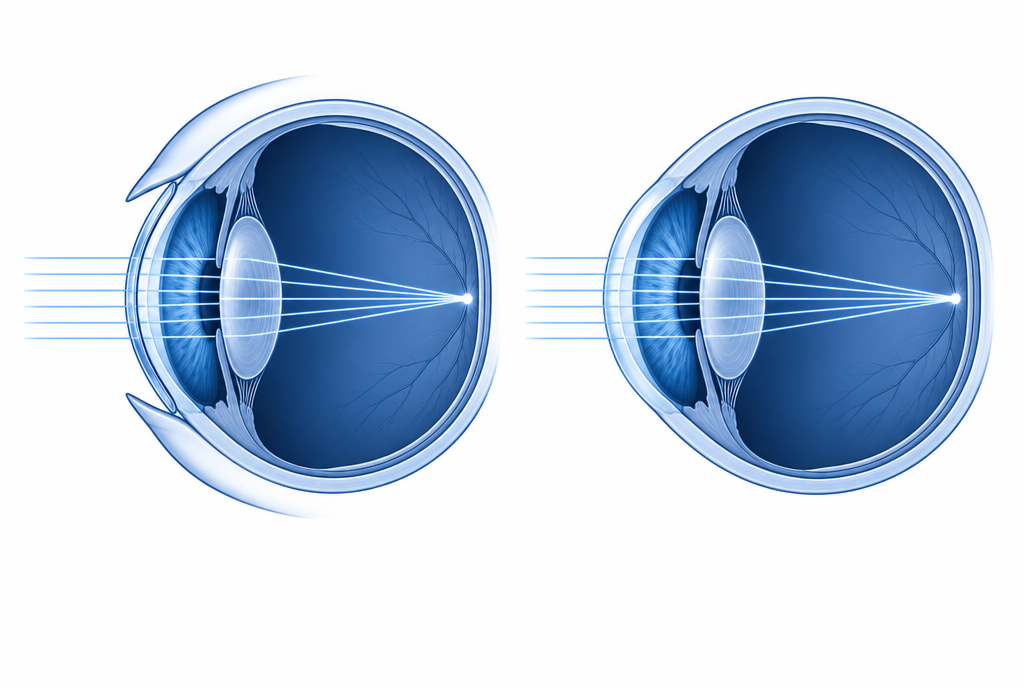
An Ortho-K lens is shaped so that, with the eyelid closed over it, it presses very lightly on the steeper central cornea and lets tear fluid redistribute the thin outer layer of cells. By morning the center is a little flatter and the area around it slightly steeper. A flatter center bends incoming light less, which moves the focus back toward the retina. Remove the lens, and that new shape holds for a while.
A few practical consequences follow from that mechanism:
- It is temporary by design. No tissue is removed. The American Academy of Ophthalmology (AAO) describes the vision change as reversible and maintained only by continued wear.
- It takes time to settle. According to the AAO, reaching the full effect can take two weeks or longer, although some people notice a clear improvement within days. A series of trial lenses, often up to three pairs, may be used before the final one is settled.
- It has limits. The cornea can only be reshaped so far. Myopia and astigmatism can be corrected together within a range, and that range is checked at the exam.
Overnight Ortho-K lenses are approved by the U.S. Food and Drug Administration (FDA) for temporarily reducing nearsightedness. They are made of rigid gas-permeable (RGP) material, which lets oxygen reach the cornea while the eye is closed.
Who it is usually considered for
GS Eye Center fits Ortho-K for two main groups.
Children and teenagers whose myopia is still progressing. Laser vision correction is not done while a prescription is still changing, so for a growing child the choices are glasses, ordinary contact lenses or a lens such as Ortho-K. The clinic notes that there is no fixed lower age limit: school-age children are fitted, and a cooperative younger child may be fitted if a parent handles the cleaning and supervision.
Adults who are not candidates for surgery, or who prefer not to have it. Some adults are told after screening that their corneas are not suited to laser correction. Others want clear daytime vision without glasses but are not ready for a permanent change. People whose work makes glasses impractical, such as athletes, flight crew, firefighters and police officers, are among those the clinic lists.
There are also situations in which Ortho-K is usually not recommended, or in which something else has to be treated first. The clinic's own list includes an active eye infection or inflammation, keratoconus and other corneal disease such as ulcers or recurrent erosion, moderate to severe dry eye, severe allergic conjunctivitis, eyelid problems that affect how the lens sits, a prescription outside the correctable range, and a wearer (or parent) who cannot keep up with daily cleaning and check-ups.
What the research says about children's myopia
This is the question most parents ask, and the honest answer has two parts.
The first part: Ortho-K has been studied as a way to slow myopia in children. In 2019 an AAO technology assessment reviewed 13 studies and concluded that Ortho-K may be effective in slowing myopic progression in children and adolescents, possibly more so when started at a younger age. In those studies, on average, the eyes of children wearing Ortho-K grew in length more slowly over two years than the eyes of children in glasses or daytime lenses. Most of the studies were done in children of Asian ethnicity, and results varied between individuals.
The second part: it does not stop myopia, and the evidence is not settled. The same review noted that progression can speed up again after the lenses are stopped or replaced with another type of correction, and it named infection as a safety concern. The AAO's patient page goes further and says there is no firm evidence yet that Ortho-K slows myopia, while noting that this is being studied.
GS Eye Center describes slowing progression during the growth years as the main reason children are fitted, and it also states that the lens cannot halt progression outright. Any effect in a particular child is judged by measuring that child's eyes over time, which is why regular check-ups are part of the plan from the start.
Dream lens, SMILE Pro, or glasses and contact lenses
The three approaches solve the same problem in very different ways. The table below shows general tendencies, not individual outcomes.
| Ortho-K (Dream Lens) | SMILE Pro | Glasses or daytime contact lenses | |
|---|---|---|---|
| How the effect lasts | Cornea is reshaped overnight; clear daytime vision lasts while you keep wearing the lens regularly | A thin disc of corneal tissue is removed once; the correction is intended to last | Correction only while you are wearing them |
| Daily care | Insert at bedtime, remove and clean every morning, store in fresh solution, regular follow-up | Eye drops and check-ups in the weeks after surgery, then routine eye exams | Glasses: cleaning only. Contacts: daily cleaning or daily disposables |
| Typical age | No fixed limit; school-age children to adults, younger children with parental care | The clinic recommends 18 or older, with a prescription stable for about six months | Any age; contacts once the wearer or a parent can manage lens care |
| Can it be undone? | Yes. Stop wearing it and the cornea gradually returns to its original shape | No. Tissue removed from the cornea does not grow back | Yes. Stop wearing them at any time |
| Main things to weigh | Infection risk from overnight wear, nightly routine, follow-up visits | Surgical risks, suitability decided by screening | Daily dependence on glasses or lenses; contacts carry their own infection risk |
Reading across the rows, the main choice is between something you keep doing every day and a single change you cannot reverse. Ortho-K sits in between: no glasses during the day, but a nightly routine that has to be maintained.
For many young adults the two are steps in sequence rather than rivals. Someone might wear Ortho-K through their teens and then consider surgery once the prescription has stopped moving. When that point has been reached is a question of records, not age alone, and our article on prescription stability and timing explains how it is judged.
Fitting, wearing and care, step by step
Ortho-K is fitted to one eye at a time, and the clinic confirms the fit before a lens goes home with you. At GS Eye Center the sequence is:
- Precision exam. The cornea's curvature and surface are mapped and vision is measured. The corneal map is the basis of the lens design.
- Trial wear and observation. A custom lens is worn and the way it sits on the cornea is checked.
- Progress check. The cornea's response is reviewed and the fit adjusted if needed.
- Final confirmation. The finished lens is confirmed for nightly use.
Once you are wearing the final lens, the routine is the same every day:
- Wash and dry your hands before touching the lens.
- Insert the lens at bedtime, as instructed for your schedule.
- Remove it in the morning and clean it straight away with the recommended solution.
- Store it in fresh solution. Replace the solution rather than topping it up, and never rinse the lens or case with tap water.
- Clean the case daily and replace it every three to six months.
- Keep every follow-up appointment, even when your vision seems fine. These visits check the corneal surface and the fit.
Stop wearing the lens and contact an eye doctor promptly if you have pain, redness, sensitivity to light, more discharge than usual, or blurred vision that does not clear. The AAO notes that infection (microbial keratitis) is the main safety concern with Ortho-K, that it can threaten vision, and that children may find hygiene harder to keep up than adults. For a child, this is where a parent's role matters most.
Because the fitting depends on follow-up visits over several weeks, it is worth asking how follow-up would work before starting, especially if you live outside Korea. Ortho-K is not something to begin at the end of a short trip and then wear without supervision.
If you later decide on surgery
Ortho-K changes the very thing a surgical screening measures. The exam for SMILE Pro or LASIK relies on maps of corneal curvature and thickness, and a cornea that has been reshaped overnight does not show its natural shape until it has had time to recover. That is why lens wearers are asked to stop for a period before screening, and why the interval for Ortho-K is usually longer than for soft lenses. The exact interval is set by the clinic for your lens and wearing history.
Our guide to what the screening exam measures explains which corneal values matter and why an altered cornea makes the plan unreliable. If you wear Ortho-K and are thinking about surgery, mention it at your first contact so the timing can be planned before you book travel.
GS Eye Center (GS안과) is an eye clinic at Gangnam Station Exit 1, Seoul, open since 2005. Alongside SMILE Pro and other vision correction, it runs a contact lens clinic that fits Ortho-K, soft lenses and RGP lenses. Fees are explained individually after the exam.
This article was reviewed by the medical team at GS Eye Center for clinical accuracy. It is general information about orthokeratology and not a diagnosis or a treatment recommendation for any individual.