Home/Blog/After You Fly Home
Aftercare · Framework guide

After You Fly Home: How Follow-up Care Works Across the Pacific

Follow-up after vision correction in Seoul rests on three things arranged before departure: an English records package, a handover plan with an eye doctor near you, and a direct line back to the clinic team. This guide explains how each part works - and what stays flexible until your consultation.

GS Eye Center International Coordination Team

Physician review pending - the published version will carry a named surgeon byline.

Read any forum thread about eye surgery abroad and the argument against it is always the same one: "what happens if something goes wrong after I fly home?" It is the most repeated question from prospective patients, more than cost, more than technology, and it deserves a structural answer rather than reassurance. This guide describes the framework we use with international patients. The specifics of your own follow-up - dates, checks, contacts - are agreed in consultation before you book anything, because they depend on your procedure and your home situation.

Why is aftercare the question that decides?

Because everything else about surgery in Korea is verifiable before you commit: the surgeon's credentials, the device platform, the facility. Aftercare is the one part of the service you cannot inspect in advance, and it is where accounts of medical travel go wrong when it is left vague. Our position is simple: a clinic treating international patients should be able to tell you, in writing and before surgery, what you will carry home, who will monitor your eyes there, and how questions reach the medical team afterward. The rest of this guide answers those three questions in order.

What records should you take home?

The single most useful thing an international patient can carry off the plane is a complete record in English. Any ophthalmologist or optometrist in the U.S. or Canada can examine post-surgical eyes; what they cannot do is guess what was done to them. Before departure, your coordinator assembles an English records package with the clinic. The contents are confirmed with you case by case, and this is what it is built to cover:

ItemWhy it matters at home
Procedure summary - what was performed, when, on which eyeThe starting point for any future eye care you receive anywhere.
Platform and treatment detailsWhether your eyes had SMILE Pro, SILK, LASIK, LASEK, or a lens implant changes how a doctor reads them years later.
Lens specification (for ICL patients)The implanted lens model and specification are lifetime reference data.
Pre-operative exam valuesYour baseline. Corneal measurements and refraction from before surgery let a local doctor judge change instead of guessing.
Medication listLets a doctor or pharmacist at home identify equivalents of your prescribed drops without deciphering Korean packaging.

If your home eye doctor wants a specific measurement included, ask your coordinator before departure - adding a value to the package in Seoul takes minutes, and chasing it across an ocean does not.

How does handover to a local eye doctor work?

Routine post-operative monitoring is standard ophthalmic work: checking vision, examining the healing cornea or the position of an implanted lens, adjusting drops. A local eye doctor can do all of it, provided they know what they are looking at - which is exactly what the records package is for.

Distance care is not improvised for foreigners, either. GS Eye Center's own Korean-language FAQ describes adjusting visit schedules for patients who live far from Seoul and coordinating continued management with eye clinics near them. The coordination service extends that same logic across borders: your in-Seoul checks are compressed into your stay, and the routine monitoring that follows is planned for where you actually live. How your particular handover is arranged - and whether any later visit to Seoul makes sense for your case - is agreed at consultation, not assumed.

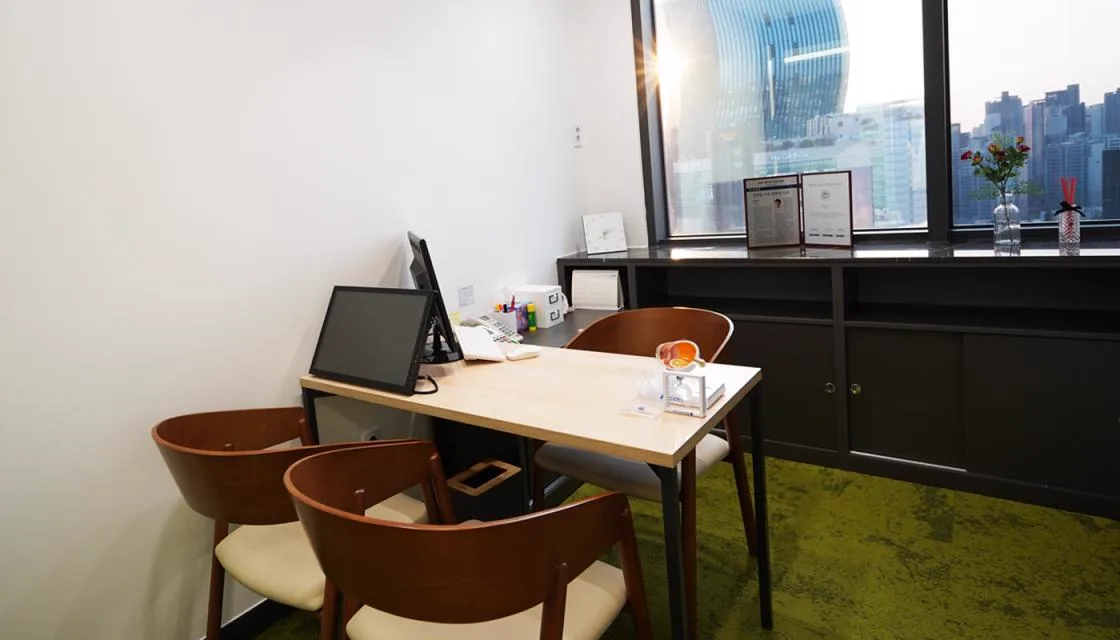
Consultation room at GS Eye Center with a desk, eye model and city view

What does a typical follow-up rhythm look like?

Treat this as orientation, not a protocol - your surgeon sets your actual schedule before you leave Seoul. In refractive care generally, checks cluster early: the day after surgery, then during the first weeks while the eye settles and drops taper, then at longer intervals over the following months. Laser patients are typically watching healing and dryness; lens-implant patients have scheduled checks built around the implant, which at GS includes ongoing aftercare examinations as part of the program. The clinic's published patient information is candid that dry eye, night glare, and halos are common early effects and describes them as mostly mild and typically improving within about six months - a useful expectation to carry home, and a reason the early months of follow-up matter even when everything feels fine.

What we deliberately do not publish is a one-size-fits-all international check-in calendar. A SMILE patient who lives in a city with easy optometry access and an ICL patient in a rural area do not need the same plan, and pretending otherwise would be marketing, not medicine.

How do you stay in contact across time zones?

The WhatsApp line and email address you used to plan the trip stay open after you land. Two things are worth knowing about how that works in practice. First, the reply standard is the same as before surgery: within one business day. Seoul is 13 to 17 hours ahead of North America, so a message sent in your evening is usually answered during the Korean workday that follows. Second, there is a review step for anything clinical: your coordinator answers logistics directly, but symptom questions are relayed to the medical team and answered after their review. That is slower than a chatbot and intentionally so - the reply you get reflects your record, not a template.

Which symptoms should skip the chat thread?

This part is general medical information, and it is the most important section on the page. A messaging line is for continuity - questions, reassurance, coordination. It is not an emergency service, and an ocean away, the clinic cannot examine you. Seek in-person eye care where you are, promptly, if you experience any of the following - then tell the clinic what was found:

  • A sudden drop or loss of vision in either eye
  • Pain that is increasing rather than settling
  • A new shower of floaters, flashes of light, or a curtain-like shadow across your vision
  • Worsening redness or discharge, especially with light sensitivity
  • Any significant injury to the eye

Your records package is what makes that local visit efficient: the doctor treating you sees the procedure, the platform, and your baseline in English, on the first visit. That is the whole design - not to replace local care, but to make sure it never starts from zero.

What should you ask any clinic before booking?

This framework is ours, but the questions travel. Whichever Korean clinic you are considering, ask in writing: What records will I take home, in English? Who monitors my eyes after I return, and how is that arranged? Whom do I contact with a concern, and how fast do you reply? What happens if I need retreatment later? A clinic that answers all four specifically, before you have paid anything, is showing you how it will behave when you are seven thousand miles away. A clinic that answers with slogans is also showing you.

Related pages: Our aftercare coordination service · Your journey, step by step · How long to stay in Seoul

FAQ

Going-home questions

Routine post-operative checks are standard eye exams that a doctor near you can perform using the handover data in your records package. Whether any return visit makes sense for your specific case is discussed at consultation - it is not assumed, and for most laser patients routine monitoring happens entirely at home.

Records are prepared in English precisely so a local doctor can work from them: procedure, platform, lens specification where relevant, baseline measurements, and medications. If your doctor has a specific format or value they want, tell your coordinator before departure and it goes into the package.

The clinic's patient information describes dryness, glare, and halos as common early effects that are mostly mild and typically improve within about six months. Message the line with what you are experiencing; if it needs examination, your records let a local doctor take over informed rather than blind.

Retreatment is assessed case by case from an exam - no one should promise it in advance. It is an area the clinic actively works in: it has published results on its Korean site using SILK for re-correction after earlier vision correction. Your records package is what makes any future assessment straightforward, in Korea or at home.

The same standard as before your trip: within one business day. Logistics and records questions come back fastest; clinical questions are relayed to the medical team and answered after their review, which is deliberate - answers should come from your record, not a template.

Free · No obligation · English support

Send your prescription today.
Know your options this week.